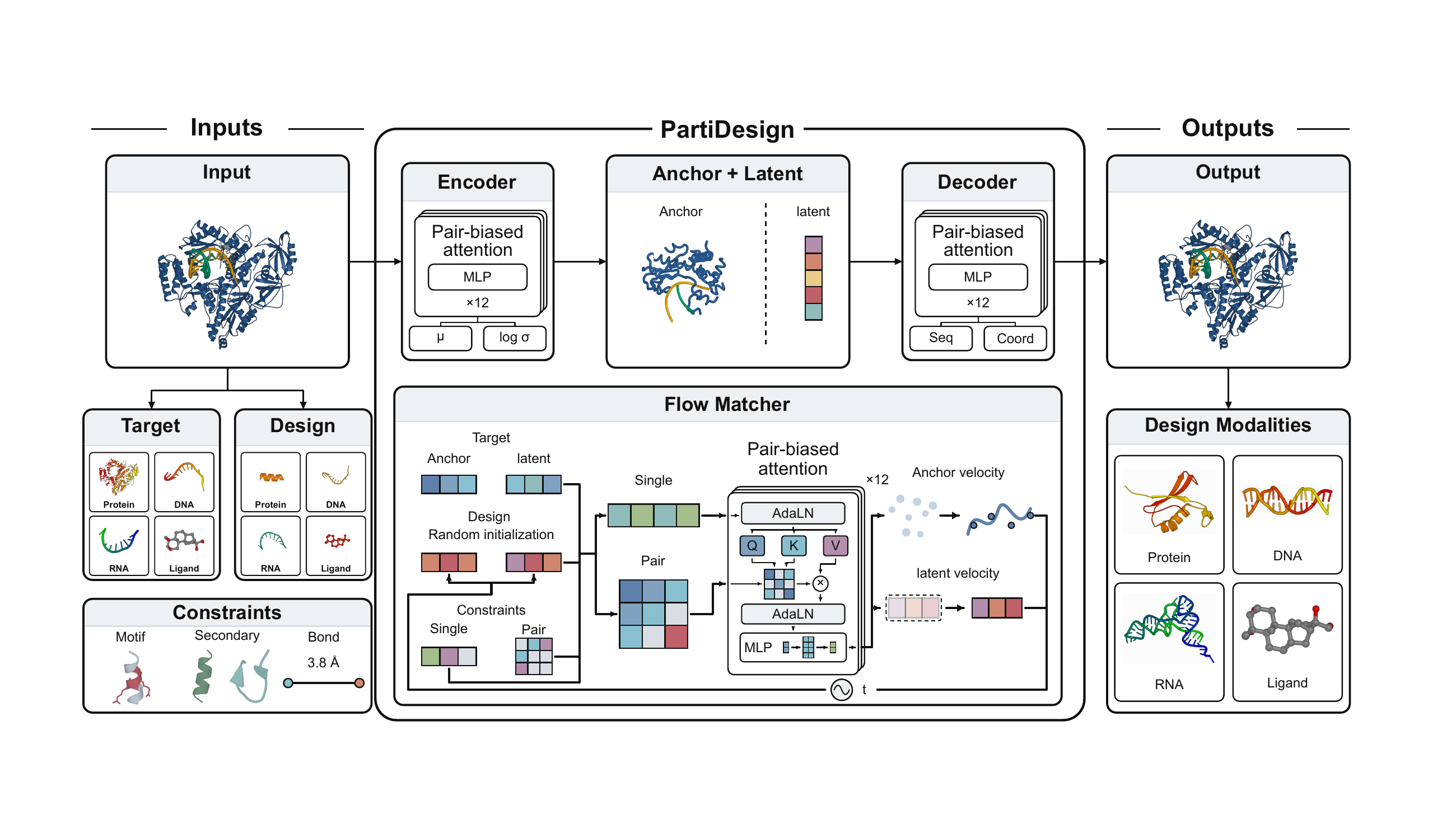
Design proteins, peptides, antibodies, DNA, RNA and small molecules — with sequences or chemical identities and three-dimensional atomic structures generated together.
Compose your conditionsFixed sequences·Motifs·Secondary structure·Hotspots·Explicit bonds
Identity and geometry, designed together.
Generate molecules on their own or in protein, nucleic-acid and small-molecule environments. Combine molecular context with the conditions that define your task.
The PartiDesign framework connects molecular context, composable conditions and joint structure–identity generation.
From new molecular identities to fixed-identity docking, use one framework with the context and constraints your design needs.
01 / PROTEIN
Proteins, peptides & antibodies
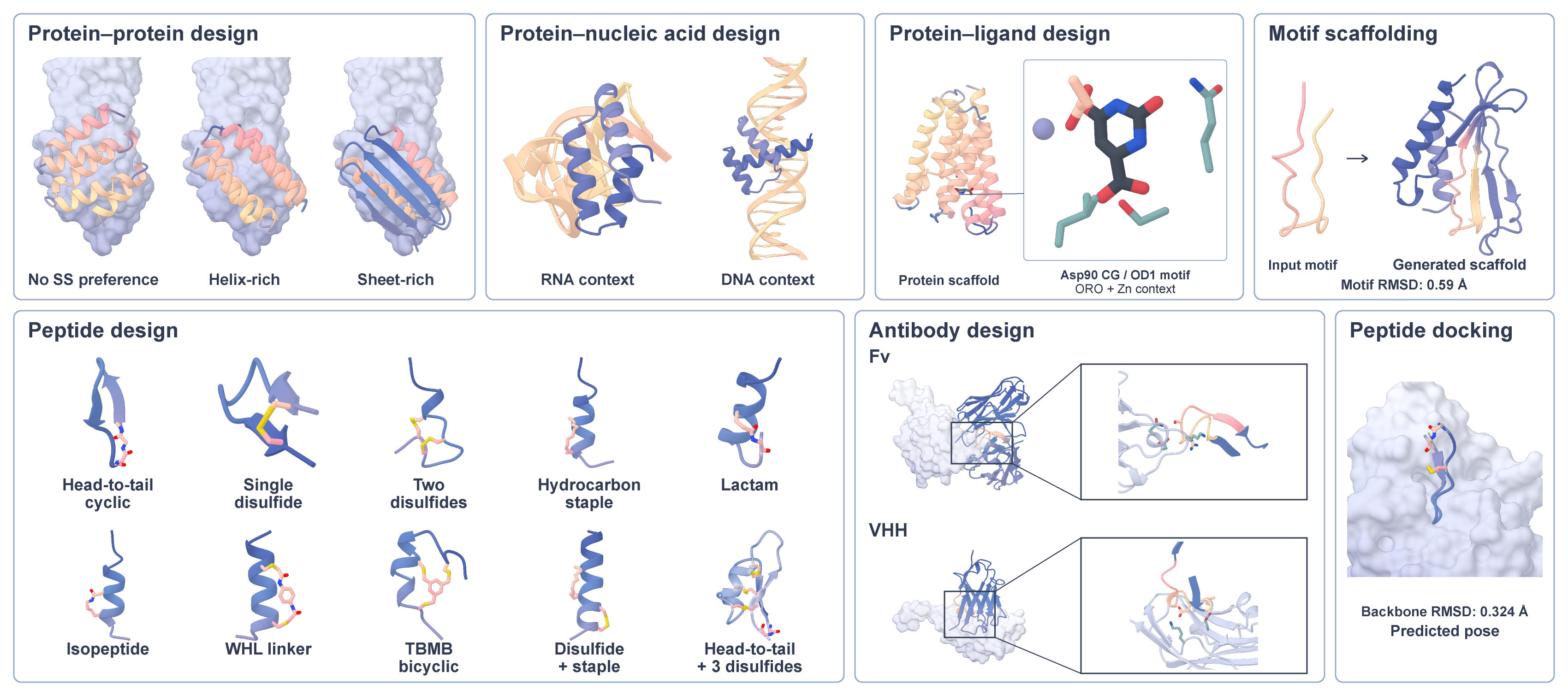
Generate monomers and binders, scaffold residue or atomic motifs, and guide secondary structure. Design linear, cyclic and crosslinked peptides, or selected CDRs in paired VH/VL and VHH scaffolds. Fixed-identity peptides support docking.
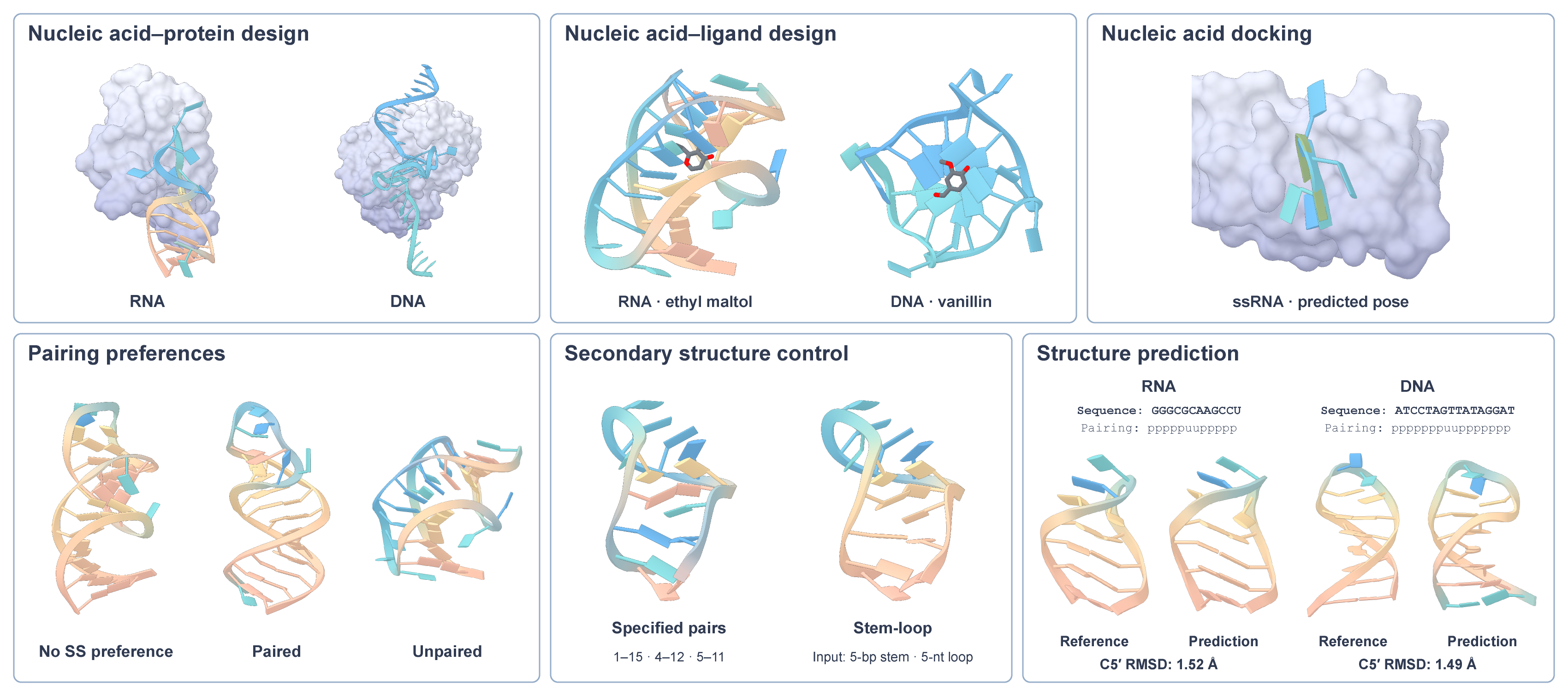
Design aptamers around proteins or small molecules, or generate structures for fixed sequences. Combine paired/unpaired, specified-pair and stem-loop guidance with sequence and motif conditions. Fixed-identity ssRNA supports docking.
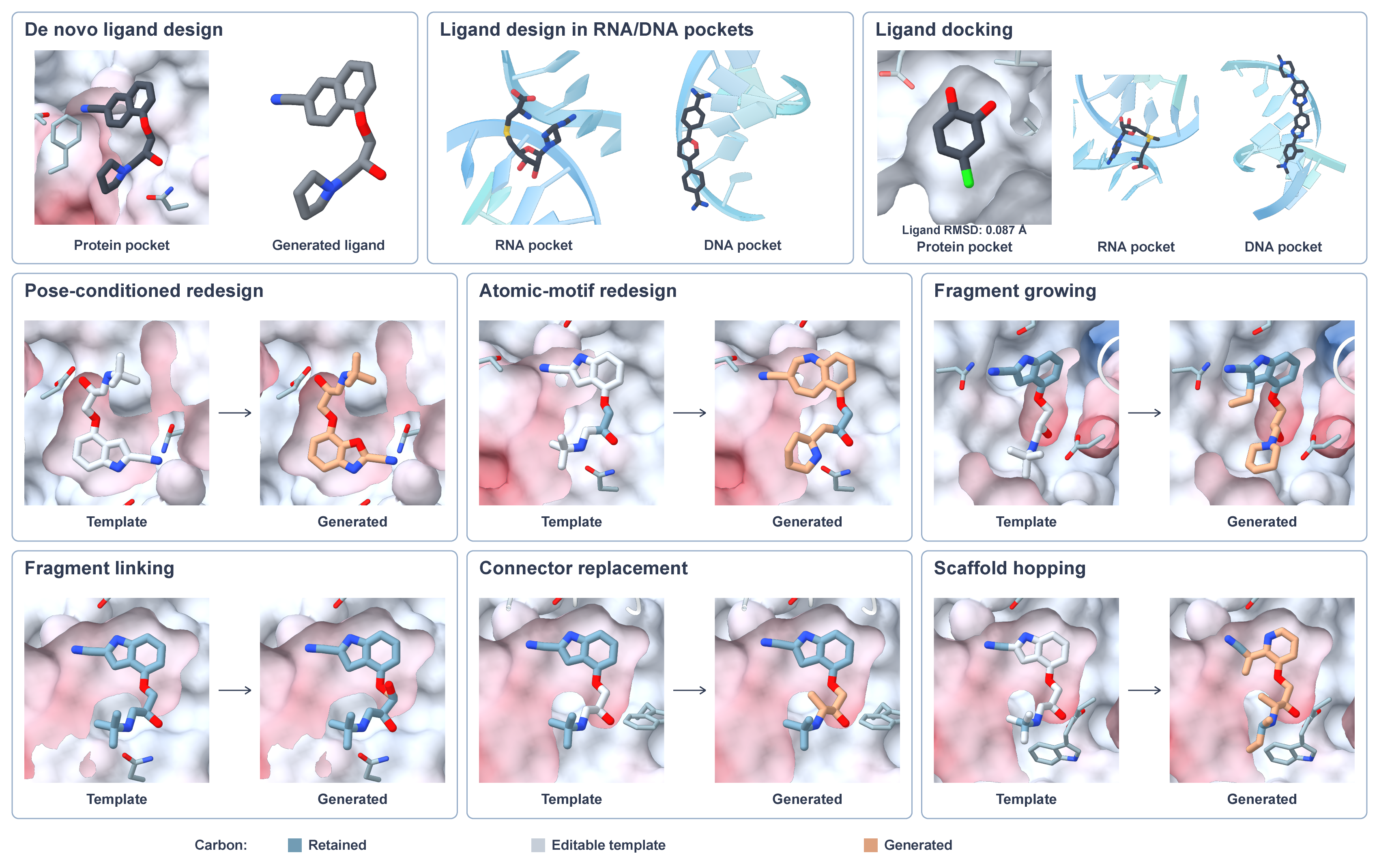
Generate pocket-conditioned ligands, grow or link retained fragments, and explore scaffold changes. Fixed-identity ligands support docking in protein or nucleic-acid context.
One command for de novo design and structure-guided redesign.
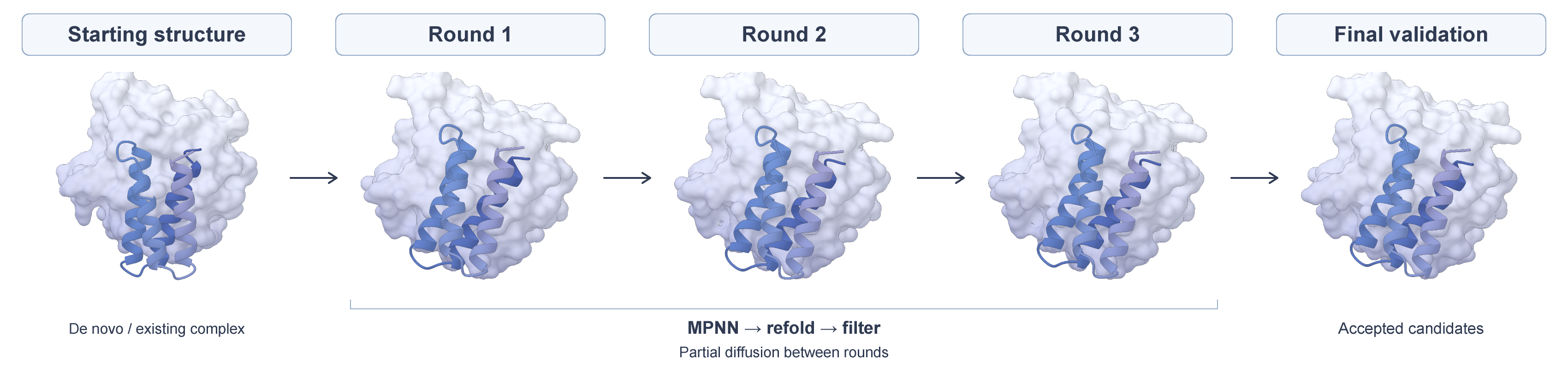
Connect generation, partial diffusion, MPNN sequence redesign, refolding and final validation in one runner. Start from a task YAML or an existing complex.
Three rounds of sequence–structure refinement, followed by final structure validation.
The lighter demo runs three rounds with ESMFold2-fast, relaxed pipeline screening and partial diffusion, followed by five Mol-1 samples for final validation. Prepare the environment and demo models below.
Optimize the bundled linear and cyclic peptide complexes. The directory’s annotation.csv describes each starting complex. This workflow begins with partial diffusion and uses the full selected preset for final validation; prepare its evaluation models.
Use the antibody preset with the bundled annotated starting complexes. Native CDR/framework permissions and the paratope declaration guide optimization. See the antibody pipeline guide for model requirements and final validation.
Add --plan to preview a command without starting model jobs.
The PartiDesign MilkyFrog skill helps set up the environment, prepare model downloads, adapt task YAML to your molecules and constraints, and run or troubleshoot design workflows.
Use $partidesign-milkyfrog to set up PartiDesign, download the models needed for the insulin receptor pipeline demo, and help me adapt a task to my target.
Set up the environment
Use Linux with an NVIDIA GPU and Conda or a compatible environment manager. Follow the commands below from your working directory.
Download the PartiDesign generation bundle and save it as ckpts/partidesign.ckpt. This checkpoint is a separate download from the environment installation.
Then prepare the additional models for the lighter insulin receptor pipeline demo:
 PartiDesign